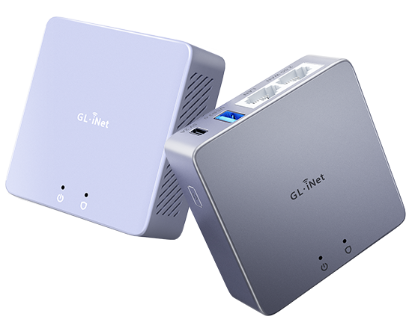
Using a VPN gateway is going to require routing to shunt the traffic to where it needs to be so I don't think 'bridged mode' or 'drop in gateway' is going to do much other than cause you problems. I'm thinking in the concept of 'layers' more than anything.
I'd go WAN -> Burme [0] -> Google [1]. That's double NAT'd but if you put your NAS on Network No. 0, you'll be able to remotely connect/VPN into it when travelling. Network No. 1 can just act as the mesh to serve mobile clients.
'Ingress' works, especially in the case of discussing VPN access into your LAN from a remote site somewhere out on the WAN/Internet.
If your device is on Network No. 0, GL.iNet default of 192.168.8.0/24, you won't have any problems. 192.168.8.1 is the GL GUI address. Note the Burme v2 only has a couple ports: WAN, LAN. That's another reason to go with something like another Flint v2 as the primary router: more Ethernet ports... the extra Wi-Fi capabilities don't hurt. The 2.5 GbE ports would be great for the NAS.
If you were on Network No. 1 trying to access the GL.iNet GUI on Network No. 0, you'd have to do some port forward finagling to pass that traffic thru that 'inner' net (relative to the 'outside' that is the WAN) but that all comes down to the capabilities of the Google device.
Bear in mind double NAT'd would mean all the clients in Network No. 1 will be shunted thru the VPN of Network No. 0 when accessing the WAN... there will be no ability to white/blacklist client devices from using it or specific VPN endpoint or otherwise. It's all or nothing.
But it all depends on what you need it to do.
Now, all that said it behooves me to mention this: GL.iNet recently announced they intend to produce a Burme v3. I mention this because it is to potentially feature three (3) Ethernet ports: WAN, 2.5 GbE, 2.5 GbE versues the Burme v2's two (WAN, 2.5 GbE — see below). A final design has not been stated so to think it would be released to production would be premature ATM to say the least. I only mention this because I wouldn't want to buy a Burme v2, with only one 2.5 GbE port for the LAN available, knowing a Burme v3 may well end up providing two (WAN, (2) 2.5GbE). If there's anything on your NAS you need to access while travelling you'll want that on Network No. 0 which means two LAN ports; one for the mesh. Either way expect the need to set up some port forwarding/firewall rules on the Google device. That device's capabilies is the real variable in all this.