Please reply with a table of the Flint 1, 2 and 3 range of each 802…. version and how much might be expected vs with a decent internal set of antennas?
ex: not real distances / just for table structure / format showing
Flint 3 / 802.11ax / if it had internal antennas / 1000ft
Flint 3 / 802.11ax / with actual external antennas / 1500ft
Based on our understanding, an antenna's gain is not significantly affected by the Wi-Fi version (e.g., Wi-Fi 6, Wi-Fi 7). It's primarily related to the radio frequency at which it operates.
Essentially, the antenna gain for all three of our models is very similar:
2.4GHz: close to 3dBi
5GHz & 6GHz: close to 5dBi
Please keep in mind that these figures are for the antenna gain alone.
The actual Wi-Fi performance you experience can be affected by various factors, including local RF restrictions and external interference in your environment.
db does not directly convert to feet of transmission. Instead, it is impacted by many factors, some being system dependent. Others env dependent. For my question, assume, line of site is open and a clean lab env or common household ambient noise.
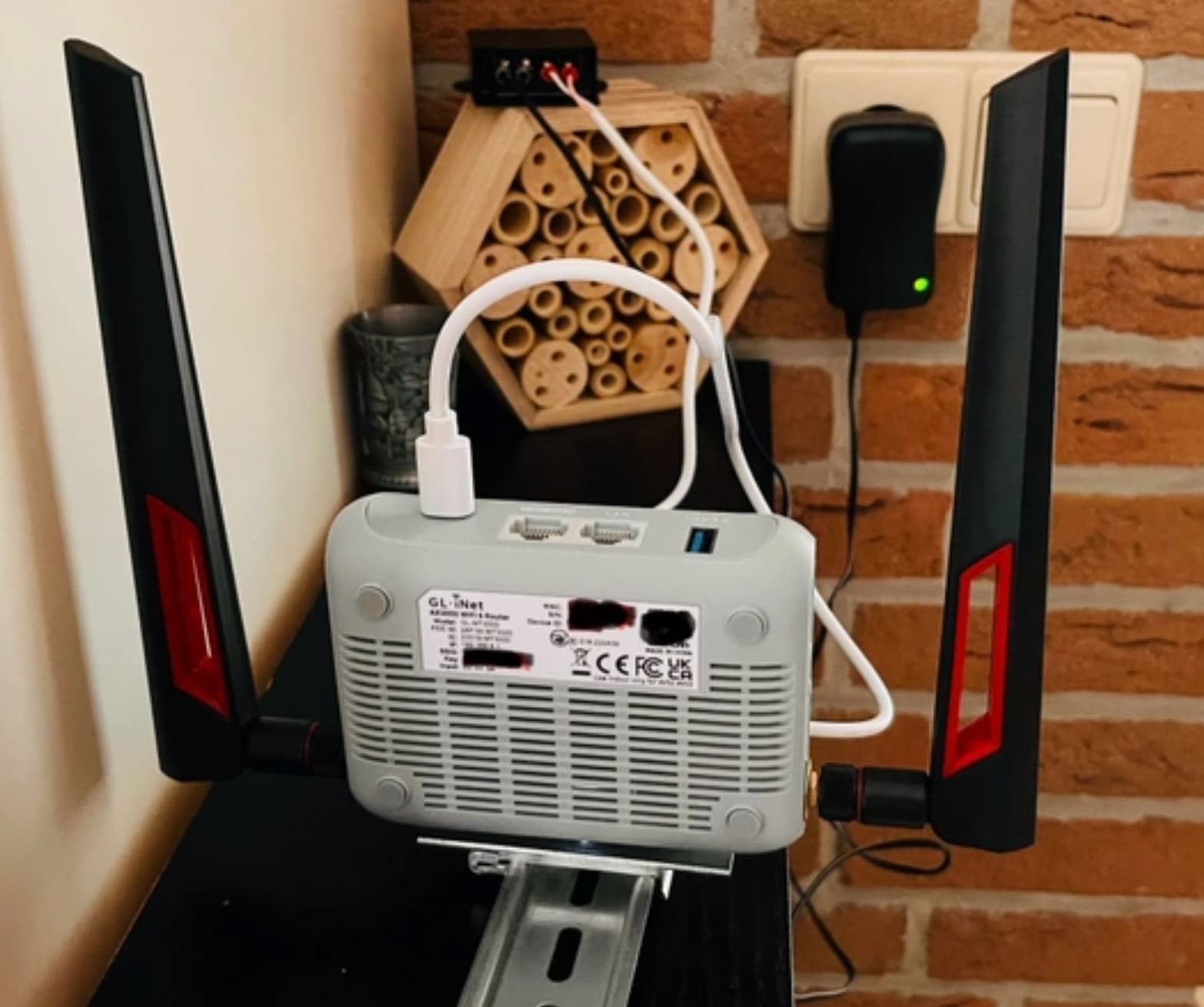
Wits Some tools and 2 right hands you can create external antenna’s. I did it myself on a Beryl AX3000, removed the original ones and replaced wits SMA connections so you can play with antenna’s. I use this one on my boot with external antenna’s to Connect to harbour WiFi.
One of the things to keep in mind is your end devices itself. Adding higher antenna gain to your ap can extend your signal, but the end device signal might not be able to reach your ap. That is why vendors try to keep the overall gain (EIRP) close to end devices in general.
For radio frequency signals, power is the only truly objective and measurable parameter. It's impossible to give a universal transmission distance because so many factors affect the signal.
These factors include:
Different power restrictions in various countries and regions.
The sensitivity of the receiver.
How much the radio waves are absorbed or blocked by different materials in your environment.
(Different transmission media, atmospheric pressure/temperature, etc.)
What you consider a "usable" Wi-Fi signal (e.g., is a detectable signal enough, or do you need a specific Mbps rate?).
Because of all these variables, we can't provide a specific number for the transmission distance.