Our little yellow Mango has been a favorite for ten years now! We know you’ve been vocal about wanting an upgrade, especially as other routers get more powerful (and a lot bigger).
Well, we’ve been listening. We’re officially bringing the topic to the table: **To make Mango V2 a reality. **
Before we dive into the nitty-gritty details, we want to hear from you. What’s on your wishlist for the successor to the OG mini router?
We can’t promise every single feature will make the cut, but we genuinely appreciate every bit of feedback you give us.
What should the next Mango look like? Drop your suggestions below!
Smaller or can accept a little bit bigger?
Is WiFi AC good or you need wifi 6/7?
Is battery needed?
What kind of ports do you need?
A touch screen?
Anything in your mind.
Smaller is better and low power is great. You have designed a lot of larger routers recently, it would be great to focus on a new small one
WIFI AC is fine for a small travel router. Please don’t go with WIFI 6/7/8 if it will take more power or size, but two radios with 2.4GHz and 5GHz would be nice.
NO BATTERY. Keep the power to a minimum and we can supply an external battery if needed. KEEP IT CHEAP AND SMALL- PLEASE
Ports: Two 1-Gbit Ethernet, 1 USB-C for other device connections, and 1 USB-C for power.
NO TOUCH SCREEN - think small, think cheap and think low power.
Final thought: Thinks small, very small
If your really wanted to make my day, make us a new USB150
I second every one of @eric suggestions. Small form factor with no battery or screen that is rugged and can be powered by most power banks and tethered to mobile device. A decent gain WiFi would be the icing on the cake.
Small, low power. Like, really…. it needs to be smaller than my travel mouse / charger. Otherwise it becomes the largest thing I carry. Current mango size is perfect, much bigger and we enter into “maybe I can go without it?” territory.
USB-C power + “gadget mode”, so that I do not need to repeat wireless or carry yet-another-converter around.
Can work with PD chargers - no need for a dedicated power supply when used “standalone”
Ethernet is nice, I think I could even live with Fast-ethernet, I rarely get Gigabit anywhere while traveling
No need for microSD-slot or storage connection or anything - do people really use this? If you have VPN back home it is very redundant
Very fast Wireguard - min ~100Mbps I would say, so that it is not a limiting factor in practical applications
This is great news. I second everything said by @eric. My suggestion is to improve wireguard speed and support Tailscale, however the most important thing is to don’t make it bigger and heavier
I love my old AR300, never had a crash or the slightest problem with it - that should be the base for an updated model. In effect, upgrade the chips, add a USB C for power and you’re nearly there already.
Small, portable, no frills, no screens, no battery, no charger etc (something the size of the first Slate would be acceptable).
Power by 5V USB C, or if this is not possible, 12V USB C with Power Delivery.
I’d like an extra USB for e.g. a printer, mobile broadband dongle, and maybe even have an M.2 interface to enable upgrade to 4G/5G broadband (add a SIM slot or better just an eSIM).
WiFi - bog standard, External antenna(e) OK but I’d like it to have the option of it working without one (programmable in GUI?).
1 WAN, 1 LAN, not bothered about the speed.
An easy to open case with a populated serial interface on the board for when things go wrong!
Awesome news. In truth, the exact same device with a more powerful processor for faster boot and VPN speeds would suit me fine. I don't need more than 300 speed and the 2.4 band.
USB-C power, as now required, but hopefully 5v 500ma to be powered by airline backseat power. Probably unrealistic.
We all carry GaN chargers for multiple devices It would be nice if there were a capacitor or battery solely for the purpose of bridging the renegotiation gap when another device is plugged in. It takes my Mango a good 3 minutes to settle down after a reboot.
1 WAN ethernet port to support the rare instance when you can do a WAN uplink. 1 LAN port for those using vanilla Openwrt who need to reset.
1 USB-A for tethering or a dongle. But no cellular support innate to the device. That is a different use model.
The ability to have two VPN tunnels and policy based routing. 4.8 level software is perfect.
Our little yellow Mango has been a community favorite for years.
As technology moves forward, we're exploring the idea of creating a next-generation mini router. But before anything takes shape, we’d love to hear from you.
What would your ideal mini router look like?
Share the features, performance, and design you’d want to see in the next evolution of Mango. While we can't promise every idea will make it into the final product, your feedback will help guide what we build next.
I would like the color to be that of an actual mango, green, yellow, orange, red etc swirled together. Maybe as a promo / limited early bird release even Obviously a more subdued color is appropriate for standard release.
On a firmware level, Would also be great to see something that better handles the various types of captive portals more effectively. After all these years since the Inception of the original Mango, I still struggle to access certain captive portals even with the more capable models of your devices whereas my phone and even something as basic as a Fire stick can do so easily and without a problem. This is indeed one vital aspect of any useful travel router.
I’d make it more stable so it wouldn’t wobble on the internet cable . It would be cool to do that through styling. I picture it as a Mini Cooper, in a rich yellow color with impressive black LED headlights. Kind of like a ….. ……GL-F300 Anniversary Edition
The smartpone and Firestick provide an interactive way to do the portal authenticaion. But the router does not. In the current firmware when you set up repeater the portal can just pop up on your phone which should be easy enough.
For routers with a screen we may consider to add some simple way to do authentication on the screen.
That would be splendid but why can that not be achieved by interacting with the router’s web UI rather than needing a screen? The fire stick, for example, doesn't have a screen but has a mini browser that can be easily cope with captive portals.
You operate your firestick on your TV right? There is nothing like this on the router.
That is not possible. It is the browser on your phone/pc accessing a webpage. The portal is a different webpage. The portal just pop up on your phone and you get it authenticated.


 Our little yellow Mango has been a community favorite for years.
 Share your thoughts in our survey: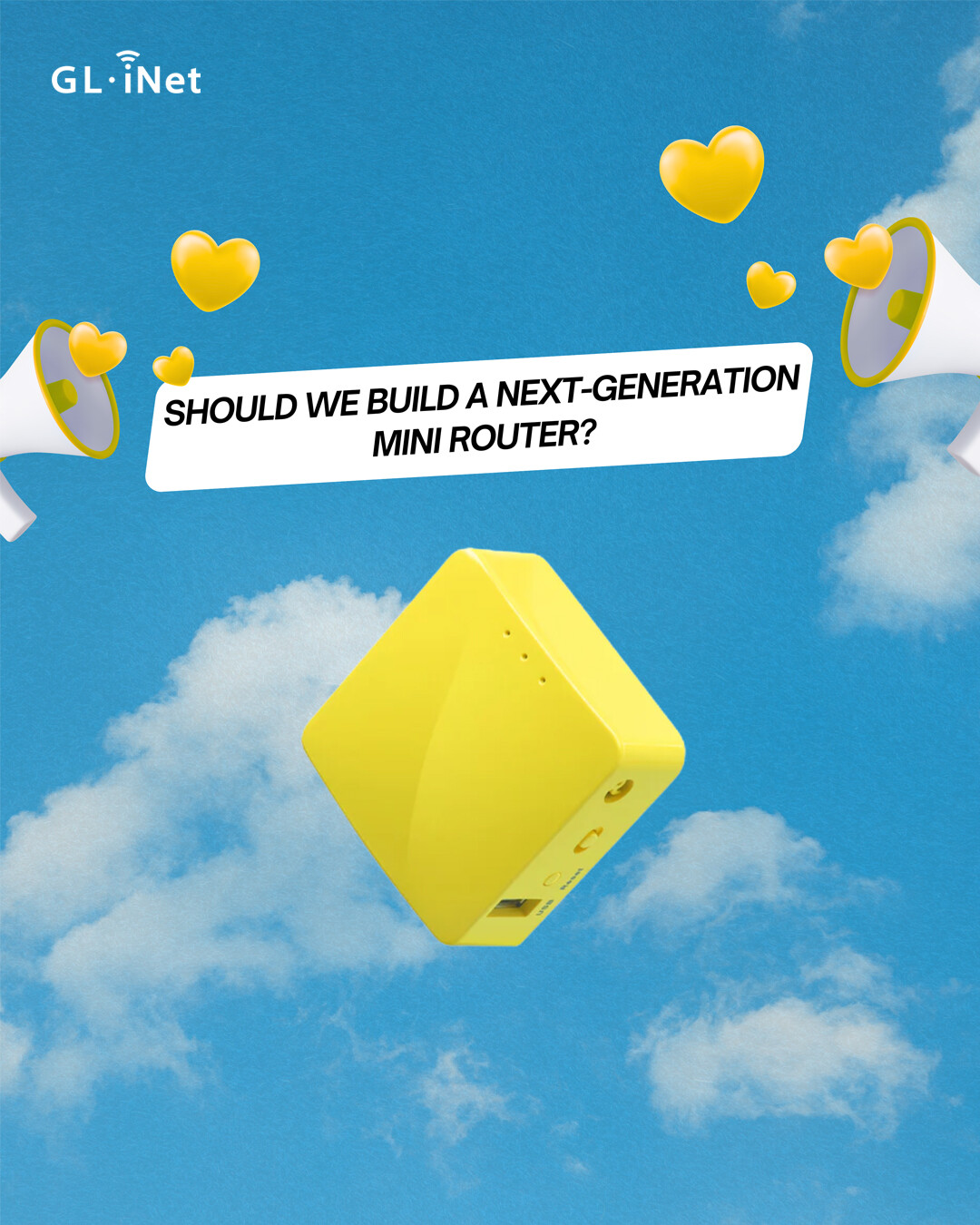

 Obviously a more subdued color is appropriate for standard release.