Anyone has 8Gbps or faster PPPoE WAN with Flint4?
Early Bird has not yet reached me, but anxioulsy waiting and wondering how my SFP+ ONU will work within flint with Orange’s 8/1Gbps PPPoE WAN
Anyone has 8Gbps or faster PPPoE WAN with Flint4?
Early Bird has not yet reached me, but anxioulsy waiting and wondering how my SFP+ ONU will work within flint with Orange’s 8/1Gbps PPPoE WAN
Hi,
We also did a test on our side using a 5 GHz Wi-Fi connection, and we did not observe a significant speed difference between VPN enabled and disabled.
If possible, could you please keep the same client device and Speedtest server during the comparison. This will help us determine whether the current performance is related to a specific VPN server/path or protocol.
Thank you for your support and understanding.
I tried at leaast 10 Proton wireguard servers, even in different countries but the outcome is the same.
Connected via ethernet there is nearly no difference between the throughput via Wireguard tunnel or not.
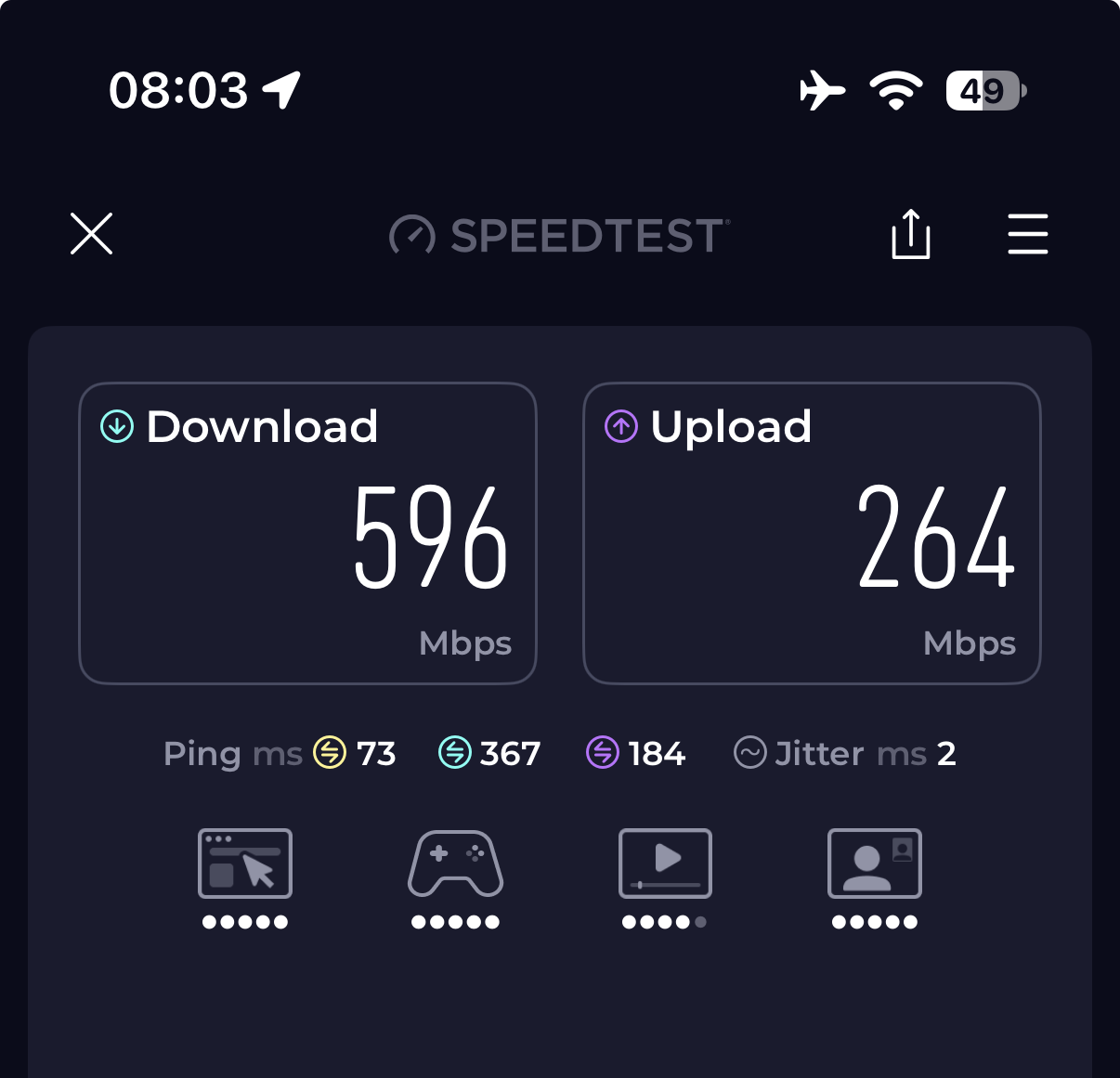
Only over Wifi (I tried 5Ghz, 7 Ghz, MLO) the throughput is halved when I use the Wireguard tunnel of the Flint 4.
Sadly I can’t test the OpenVpn option of Proton because the router does not let me authenticate (using the correct pwd and login) the connection.
Oh and I tried (my still active) Torguard Wireguard account and there I have the same results although it is not as fast as Proton but over Wifi the throughput is halved when active.
So please explain me why the trhoughput is not halved when connected via an ethernet cable to the router and is halved when I use Wifi?
Without the tunnel active both my mobile devices get nearly 1 Gbps throughput up/down and with tunnel active only half.
Please explain me why it is?
I tested the Flint 2 ( I use it as travel router) also and there this problem does not exist although it is not that fast throughput wise.
Is there anyone from GL.iNet that can comment on when we might get an upgrade of the base software from OpenWRT v21 to v25? Please…. I have really nice hardware with my new Flint 4, and a dinosaur for software without any of the new gee whiz features (I need to roam all over my house with the Flint’s, Slates, etc). So yes I need the upgrades on other GL.iNet routers also, but I figured the latest and greatest would have the updated software when I got it. 
@tobyayre You can now build your own firmware for the Flint 4, based on the latest OpenWrt mainline (kernel 6.18.44). Feel free to test it out and share your feedback.
It took years for the MT6000 and MT3000 to receive official OpenWrt support, and hopefully the Flint 3 will follow very soon.
GL.iNet also used official support for newer OpenWrt versions as a selling point for both the MT3000 and MT6000.
If official OpenWrt support is important to you, I think the Flint 4 may not have been the best choice at this point.
Thank you! I will give it a shot!
Hey there… thanks for the honest feedback. It is not so much all of the openwrt… it is more things like native WiFi 7 stacks, and better 6GHz handling, upgraded Linux. Anyway thank you for the input.
Hi,
Thank you again for the detailed testing and information.
Normally, enabling a VPN may cause some performance loss, but Wi-Fi traffic passing through a VPN should not generally cause the throughput to drop to around half of the original speed.
In our previous local testing, the Wi-Fi throughput of the test environment itself did not exceed around 600 Mbps, so it may not have been sufficient to reproduce the behavior you are seeing.
We will perform another test in a higher-throughput environment and try to reproduce and further investigate the issue.
We will follow up if there are any new findings. Thank you for your understanding and patience.
I'm waiting for my Flint 4, reading this topic I can see that OpenWrt is version 21.2. From the firmware download page, there is no mention of anything but the initial firmware which I suppose 21.2. Right?
That’s correct. Only the initial release that shipped in the devices is available as of this message.
Hoping a newer version will be released soon as there’s a bug from v4.9.0 in there that is affecting those that use Adguard Home.
I’d love to use both 10G ports but neither my ISP nor my network was built with SFP+ in mind.
Has anyone purchased, tried and is happy with a good adapter to recommend?
Darn! I am using Adguard Home with my Flint 2. What bug are you referring to?
The Flint 4 I received was on firmware V4.9.1..
Not the V4.9.0.
I have the exact same issue. Got my preorder today. Immediately noticed half speeds over WiFi using WireGuard client as primary VPN tunnel.
i have speed test tracker running every 2 hours on my Ethernet connection and the throughput is as expected - over 900mbps
on iPhone on MLO, 5G and 6G sat right next to router I cannot get more than 400mbps
both connections route through WireGuard client primary VPN tunnel.
WiFi is approx half throughput!
All Flint 4’s were delivered with the only FW currently available for them, v4.9.1….
Charles2 for info… I already had the GL INET network acceleration turned on and set to hardware in the UI when this issue presents. In addition, last night I installed the luci module and activated hardware offloading and was able to achieve marginally higher speed over wifi - from approx 430mbps to 600mbps, however still cannot receive the full speed of 980mbps that my ethernet interface is able to. Again all other variables are the same - same vpn tunnel, same servers used for testing across both interfaces, testing conducted within 60 seconds of eachother.
So there is still some sort of hardware/firmware bottleneck or additional misconfigured settings that is causing reduced throughput. I specifically bought this router as it advertised capability to achieve 1.5gbps wireguard VPN speed over wifi. Note the other topics on this board where additional users have also flagged this issue. (FYI i dont want hardware offloading enabled as want to keep SQM, Flint 4 CPU is supposed to be more than capable isn’t it?)
Ethernet
Wifi with hardware offloading enabled in Luci
Hello, everyone
Thank you all for your patience, detailed testing, and continued feedback on this issue.
We have further reviewed the performance difference between using WireGuard over Ethernet and over Wi-Fi.
When VPN traffic is forwarded from a wired LAN client, most of the processing overhead comes from VPN forwarding and encryption. When the client is connected through Wi-Fi, the router also needs to handle the additional Wi-Fi traffic processing and forwarding at the same time.
Because of this additional processing overhead, the maximum VPN throughput from a Wi-Fi client can be lower than the throughput measured from an Ethernet client.
We have shared this issue with the relevant team for further investigation and evaluation, and appropriate adjustments or optimizations will be considered based on the findings.
Thank you again to everyone who helped with the testing and provided detailed comparison results.
It can be that connecting to Wifi the throughput can be a bit slower but in this case it is even more than 50%!
I tested last week with my flint 2 and there is the loss against wired maximum 10% which is acceptable but 50% absolutely not!!