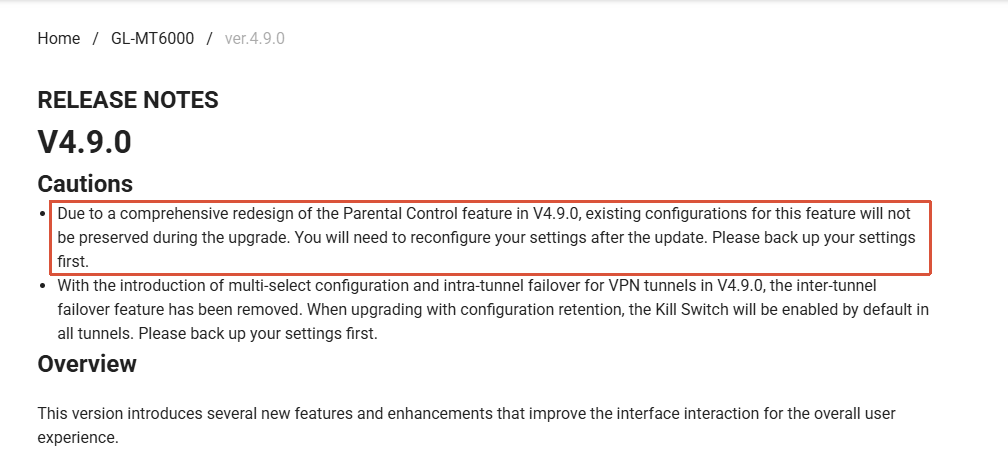
After upgrading my GL‑MT6000 (Flint 2) to firmware v4.9, I encountered several critical regressions that significantly impact the device’s security and reliability.
Removal of “Block WAN for Unmanaged Devices” (drop_anonymous) The global default‑deny policy for unknown devices has been removed from Parental Control. This was the only reliable protection against randomized MAC addresses and an essential safeguard in case of Wi‑Fi credential exposure. I would appreciate clarification on why this feature was removed and whether it is planned to return.
No configuration migration The upgrade overwrote the entire configuration, including:
-
all Parental Control groups and schedules,
-
30+ MAC assignments,
-
custom Nginx reverse proxy settings,
-
language and localization files. All configuration had to be rebuilt manually from scratch.
LuCI Statistics broken LuCI now reports missing RRD/collectd components, indicating that required modules were removed or corrupted during the upgrade.
Summary I have been using this device since April 2026, and this is my second firmware upgrade. The extent of issues introduced in v4.9 is unexpected, especially given GL.iNet’s positioning as a provider of stable and reliable software. Compared to my experience with Turris devices, this update represents a noticeable step backward.
I would like to understand whether users are expected to manually reconstruct core network configurations after major updates. For most users, this is not a practical workflow.
I assume this behavior is not intended. However, if this level of disruption is to be expected in future releases, operating this device becomes an unsustainable time burden. I do not have the capacity to audit and repair my network after every update. I also hope that the declining usability of the device is not becoming the new standard for GL.iNet products.
If this reflects the long‑term direction of your software lifecycle, it makes further investment into GL.iNet hardware unjustifiable.
I request an official response from the GL.iNet development team.