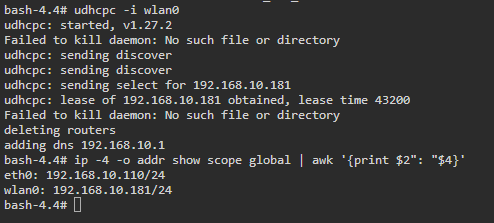
Since you are not sharing the kernel sources used to build the firmware of the comet, could you please include some wireless drivers so that we can use a wireless usb adaptor?
In my case, I am trying to use a AR9271 or MT7601u. The drivers for these 2 chips are included in the vanilla 4.19.111 kernel. I tried compiling the drivers myself with assistance from ChatGPT, but was unsuccessfull!
I'm NOT asking to include Wifi options in the GUI! just make it so that we can plug the USB devices and work with it ourselves from the terminal.
Great news! It works!!! The web server on the device is configured to listen on all interfaces. I am able to open the web interface via both IPs!
Only hiccup is that the firmware files were not included. By manually adding them into /lib/firmware, they aren't picked up at boot since the overlay file system is mounted after everything is loaded. That's my fault for forgetting to request these files be added!
Simulating a usb disconnect/connect makes everything work!
If you could please also add the following firmwares in /lib/firmware and /lib/firmware/ath9k_htc (they are included in the vanilla kernel) :
For those who also want to have wireless on the Comet: I specifically chose those 2 wireless adaptors (MT7601 and AR9271) because they are properly supported in the vanilla linux kernel on arm. Yes they are only 802.11b/g/n 2.4ghz, but they will just work! Atheros AR9271 is a better choice since the stack is fully open-source! You can find them for a few bucks on Aliexpress!
Could you please make a short instruction on how to run all this on the current firmware version (including connecting to the wifi network)? Thanks!
BTW, AR9271 looks too old and is not sold in regular stores. Maybe it is worth adding more modern chipsets?
They are currently not included in the firmware and the wifi firmware files are missing. Since the wifi firmware has to be manually downloaded on the device, you have to dicsonnect and reconnect the wifi adaptor after every boot. You can script this, but I would just wait for them to include those 2 extra files (they are included with the vanilla kernel, they just need to add them). Once they are included, I can provide the setup.
The last paragraph of my post explains why these controllers were chosen. Unlike modern chipsets, they require zero fiddling and just work. GLinet will not go through hoops to make random network drivers work. You can order one from Aliexpress for a few dollars.
As stated in the 6th post, since the firmware files were not included (only the drivers), they have to manually added and plug/unplug the USB after every reboot.
Here's the situation: If you're willing to patiently collaborate with us on some testing—for instance, if you know the model of your Wi-Fi card and can locate its firmware—we can compile a custom firmware for you to try. If it works, it might be integrated into the project.
But I still need to mention. I learned from the hardware department that on non-RM1 projects, the current for the USB-A port is limited to 500mA (while RM1 supports 1A). I'm not sure if this might cause some USB Wi-Fi adapters to malfunction. It is still recommended to purchase the RM10 directly if Wi-Fi functionality is needed.
Hmm, at first, i’m a bit lost what chipset has advantages. i could only speculate from nearly no knowledge.
What i think is that chipsets with 5g support have advantages over good old matured chipset with only 2.4g . Maybe someone with more knowledge about that and what chipset has most support or is easy to support can jump in.
Independent of that i’m willing to help.
I do not understand your last sentence. Do you mean that the RM1 can draw up to 1A but can only deliver up to 500mA? That would prevent the usage of wifi6 sticks because they have high peaks of current draw. As far as i know.
Totally agree with buying a RM10. I would if there where different paying methods than credit card. So i’m sorry, i have to stick with what i have bought at amazon.