Hello Bruce,
thank you for the clarification. I think I understand how your current logic works — DNS traffic is split depending on the destination policy (include/exclude).
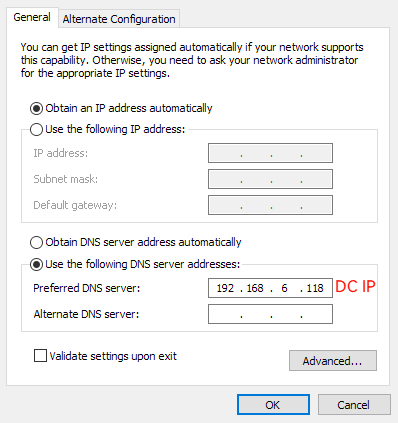
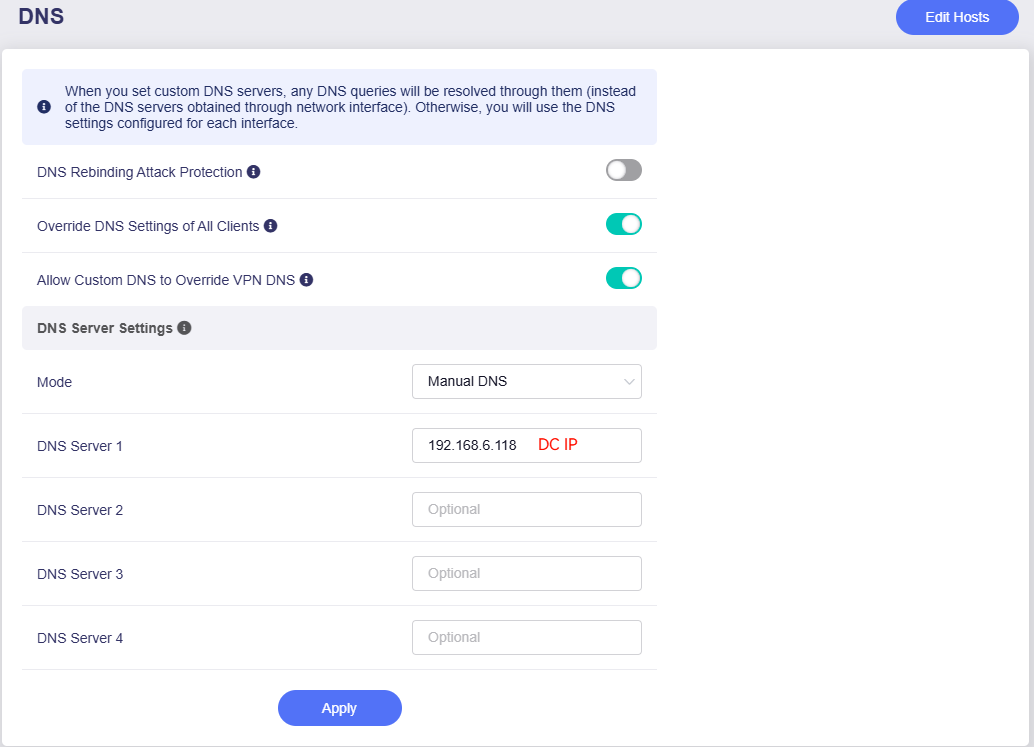
However, this logic doesn’t fit setups where the DNS server itself is located behind the VPN — for example, when the VPN server side has a Windows Domain Controller (DC) providing DNS via DHCP.
In this situation:
-
The client must always send all DNS queries through the VPN, because the only valid resolver is the remote DC.
-
The DC DNS decides where each domain should go — internal or external.
-
If GL.iNet splits DNS before it reaches the DC, the lookup fails or resolves with wrong results.
That’s why in my setup, include breaks the DNS logic:
DNS packets never reach the remote DC, because they’re already handled locally.
The only way to make it work is exclude, which forces everything through the tunnel first — but that requires a huge exclude list.
So the problem is not that DNS cannot “reach” the DC — it’s that GL.iNet’s current policy engine decides DNS direction before the DNS query can even reach the correct server.
For corporate or AD environments, DNS must be treated as service routing, not destination-based routing.
I’ll still collect the ipset list and syslog for your reference.
Best regards,
Dustin
___________________________________________
BusyBox v1.33.2 (2025-09-04 11:11:17 UTC) built-in shell (ash)
| |.-----.-----.-----.| | | |.----.| |_
| - || _ | -| || | | || || |
|_____|| |||||___||| |____|
|| W I R E L E S S F R E E D O M
OpenWrt 21.02-SNAPSHOT,
root@GL-XE3000:~# ipset list
Name: dst_net10
Type: hash:net
Revision: 6
Header: family inet hashsize 1024 maxelem 65536
Size in memory: 2760
References: 1
Number of entries: 38
Members:
196.0.0.0/6
193.0.0.0/8
112.0.0.0/5
16.0.0.0/4
126.0.0.0/8
176.0.0.0/4
173.0.0.0/8
192.192.0.0/10
32.0.0.0/3
1.0.0.0/8
160.0.0.0/5
64.0.0.0/3
12.0.0.0/6
168.0.0.0/6
192.170.0.0/15
194.0.0.0/7
200.0.0.0/5
120.0.0.0/6
172.0.0.0/12
10.0.0.0/8
192.176.0.0/12
192.128.0.0/11
172.64.0.0/10
4.0.0.0/6
124.0.0.0/7
128.0.0.0/3
172.128.0.0/9
208.0.0.0/4
8.0.0.0/7
192.0.0.0/9
192.169.0.0/16
192.160.0.0/13
172.32.0.0/11
174.0.0.0/7
192.172.0.0/14
2.0.0.0/7
96.0.0.0/4
11.0.0.0/8
Name: dst_net10_6
Type: hash:net
Revision: 6
Header: family inet6 hashsize 1024 maxelem 65536
Size in memory: 1240
References: 0
Number of entries: 0
Members:
Name: dst_net1832
Type: hash:net
Revision: 6
Header: family inet hashsize 1024 maxelem 65536
Size in memory: 2824
References: 1
Number of entries: 37
Members:
172.32.0.0/11
120.0.0.0/6
126.0.0.0/8
32.0.0.0/3
192.0.0.0/9
174.0.0.0/7
11.0.0.0/8
176.0.0.0/4
192.170.0.0/15
192.128.0.0/11
192.176.0.0/12
124.0.0.0/7
192.192.0.0/10
8.0.0.0/7
194.0.0.0/7
208.0.0.0/4
4.0.0.0/6
172.0.0.0/12
172.64.0.0/10
193.0.0.0/8
192.169.0.0/16
173.0.0.0/8
64.0.0.0/3
160.0.0.0/5
192.172.0.0/14
1.0.0.0/8
12.0.0.0/6
196.0.0.0/6
96.0.0.0/4
172.128.0.0/9
200.0.0.0/5
168.0.0.0/6
16.0.0.0/4
128.0.0.0/3
192.160.0.0/13
2.0.0.0/7
112.0.0.0/5
Name: dst_net1832_6
Type: hash:net
Revision: 6
Header: family inet6 hashsize 1024 maxelem 65536
Size in memory: 1240
References: 0
Number of entries: 0
Members:
Name: GL_MAC_BLOCK
Type: hash:mac
Revision: 0
Header: hashsize 1024 maxelem 65536
Size in memory: 200
References: 1
Number of entries: 0
Members:
root@GL-XE3000:~#
________________________________
Fri Oct 31 11:53:47 2025 daemon.info dnsmasq[21110]: using nameserver x.x.x.x#53
Fri Oct 31 11:53:47 2025 daemon.info dnsmasq[21110]: using nameserver 8.8.8.8#53
Fri Oct 31 11:53:47 2025 daemon.info dnsmasq[21110]: using nameserver 8.8.4.4#53
Fri Oct 31 11:53:47 2025 daemon.info gl-repeater[3224]: (repeater.lua:1731) interface "wwan" up
Fri Oct 31 11:53:47 2025 daemon.notice netifd: wwan (21667): PING x.x.x.x (x.x.x.x): 56 data bytes
Fri Oct 31 11:53:47 2025 daemon.info glc: (common.c:1741) Parse +COPS response success
Fri Oct 31 11:53:47 2025 daemon.notice netifd: wwan (21667): 64 bytes from x.x.x.x: seq=0 ttl=64 time=9.368 ms
Fri Oct 31 11:53:47 2025 daemon.notice netifd: wwan (21667):
Fri Oct 31 11:53:47 2025 daemon.notice netifd: wwan (21667): --- x.x.x.x ping statistics ---
Fri Oct 31 11:53:47 2025 daemon.notice netifd: wwan (21667): 1 packets transmitted, 1 packets received, 0% packet loss
Fri Oct 31 11:53:47 2025 daemon.notice netifd: wwan (21667): round-trip min/avg/max = 9.368/9.368/9.368 ms
Fri Oct 31 11:53:47 2025 user.notice kmwan: config json str={ "op": 6, "data": { } }
Fri Oct 31 11:53:48 2025 user.notice kmwan: config json str={ "op": 2, "data": { "cells": [ { "interface": "wwan", "netdev": "apclix0", "track_mode": "force", "addr_type": 4, "force_ip": "x.x.x.x", "tracks": [ { "type": "ping", "ip": "1.1.1.1" }, { "type": "ping", "ip": "8.8.8.8" }, { "type": "ping", "ip": "208.67.222.222" }, { "type": "ping", "ip": "208.67.220.220" } ] } ] } }
Fri Oct 31 11:53:48 2025 kern.debug kernel: [ 67.893721] [add_dev_config 319]add node success. iface:wwan, dev:apclix0, ifindex:12
Fri Oct 31 11:53:48 2025 daemon.info gl-repeater[3224]: (repeater.lua:1738) interface wwan status offline
Fri Oct 31 11:53:48 2025 daemon.info glc: (common.c:1741) Parse +COPS response success
Fri Oct 31 11:53:48 2025 user.notice firewall: Reloading firewall due to ifup of wwan (apclix0)
Fri Oct 31 11:53:48 2025 daemon.info avahi-daemon[7852]: Joining mDNS multicast group on interface apclix0.IPv6 with address fe80::ecee:71ff:fe39:7758.
Fri Oct 31 11:53:48 2025 daemon.info avahi-daemon[7852]: New relevant interface apclix0.IPv6 for mDNS.
Fri Oct 31 11:53:48 2025 daemon.info avahi-daemon[7852]: Registering new address record for fe80::ecee:71ff:fe39:7758 on apclix0.*.
Fri Oct 31 11:53:49 2025 kern.debug kernel: [ 69.236179] Set_ByPassCac_Proc(): set CAC value to 1
Fri Oct 31 11:53:49 2025 kern.debug kernel: [ 69.538442] BcnCheck start after 2500 ms (ra0)
Fri Oct 31 11:53:49 2025 kern.debug kernel: [ 69.542886] BcnCheck start after 2500 ms (ra0)
Fri Oct 31 11:53:49 2025 daemon.info gl-repeater[3224]: (repeater-portal.lua:395) portal detecting...
Fri Oct 31 11:53:50 2025 daemon.info gl-repeater[3224]: (repeater.lua:1738) interface wwan status online
Fri Oct 31 11:53:50 2025 daemon.info gl-repeater[3224]: (repeater-portal.lua:418) not found portal
Fri Oct 31 11:53:52 2025 cron.err crond[7473]: time disparity of 3112 minutes detected
Fri Oct 31 12:38:10 2025 kern.debug kernel: [ 2729.580780] entrytb_aid_aquire(): found non-occupied aid:5, allocated from:4
Fri Oct 31 12:38:10 2025 kern.warn kernel: [ 2729.587881] 7981@C13L2,MacTableInsertEntry() 1577: New Sta:xx:xx:xx:xx:xx:xx
Fri Oct 31 12:38:10 2025 kern.notice kernel: [ 2729.598280] 7981@C08L3,ap_cmm_peer_assoc_req_action() 1714: Recv Assoc from STA - xx:xx:xx:xx:xx:xx
Fri Oct 31 12:38:10 2025 kern.notice kernel: [ 2729.607739] 7981@C08L3,ap_cmm_peer_assoc_req_action() 2241: ASSOC Send ASSOC response (Status=0)...
Fri Oct 31 12:38:10 2025 kern.notice kernel: [ 2729.616940] 7981@C01L3,wifi_sys_conn_act() 1115: wdev idx = 2
Fri Oct 31 12:38:10 2025 kern.notice kernel: [ 2729.623118] 7981@C08L3,hw_ctrl_flow_v2_connt_act() 215: wdev_idx=2
Fri Oct 31 12:38:10 2025 kern.notice kernel: [ 2729.747008] 7981@C15L3,WPABuildPairMsg1() 5310: <=== send Msg1 of 4-way
Fri Oct 31 12:38:10 2025 kern.notice kernel: [ 2729.753688] 7981@C15L3,PeerPairMsg2Action() 6303: ===>Receive msg 2
Fri Oct 31 12:38:10 2025 kern.notice kernel: [ 2729.760474] 7981@C15L3,WPABuildPairMsg3() 5595: <=== send Msg3 of 4-way
Fri Oct 31 12:38:10 2025 kern.notice kernel: [ 2729.767173] 7981@C15L3,PeerPairMsg4Action() 6734: ===>Receive msg 4
Fri Oct 31 12:38:10 2025 kern.warn kernel: [ 2729.778721] 7981@C15L2,PeerPairMsg4Action() 7098: AP SETKEYS DONE(rax0) - AKMMap=WPA2PSK, PairwiseCipher=AES, GroupCipher=AES, wcid=2 from xx:xx:xx:xx:xx:xx
Fri Oct 31 12:38:13 2025 daemon.info dnsmasq-dhcp[21110]: DHCPDISCOVER(br-lan) xx:xx:xx:xx:xx:xx
Fri Oct 31 12:38:13 2025 daemon.info dnsmasq-dhcp[21110]: DHCPOFFER(br-lan) x.x.x.x xx:xx:xx:xx:xx:xx
Fri Oct 31 12:38:13 2025 daemon.info dnsmasq-dhcp[21110]: DHCPREQUEST(br-lan) x.x.x.x xx:xx:xx:xx:xx:xx
Fri Oct 31 12:38:13 2025 daemon.warn dnsmasq-dhcp[21110]: Ignoring domain dwnet.intern for DHCP host name x
Fri Oct 31 12:38:13 2025 daemon.info dnsmasq-dhcp[21110]: DHCPACK(br-lan) x.x.x.x xx:xx:xx:xx:xx:xx x
Fri Oct 31 12:39:21 2025 kern.notice kernel: [ 2800.221288] 7981@C15L3,PeerGroupMsg1Action() 7167: ===>Receive group msg 1
Fri Oct 31 12:53:21 2025 daemon.notice netifd: modem_0001_4 (12236): udhcpc: sending renew to x.x.x.x
Fri Oct 31 12:53:21 2025 daemon.notice netifd: modem_0001_4 (12236): udhcpc: lease of x.x.x.x obtained, lease time 7200
Fri Oct 31 12:53:21 2025 user.notice kmwan: config json str={ "op": 6, "data": { } }
Fri Oct 31 13:07:53 2025 authpriv.info dropbear[13424]: Child connection from x.x.x.x:12246
Fri Oct 31 13:08:02 2025 authpriv.notice dropbear[13424]: Password auth succeeded for 'x' from x.x.x.x:12246
 DNS itself already works correctly
 The issue is that WireGuard policy routing modifies DNS traffic, depending on include/exclude rules.
 What is needed