Is it possible to bond the LAN ports on the Flint 3 using either static link aggregation or LACP 802.3ad? I don't mind using the command line to do it, I just need to know if the switch chip supports this and if so, how to set it up.
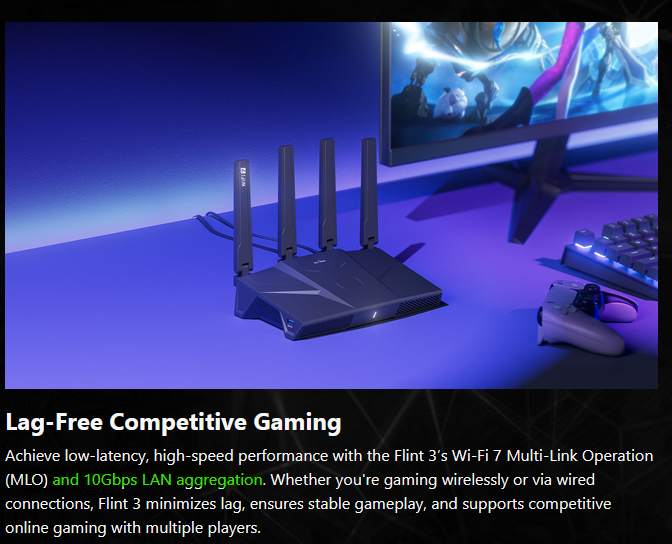
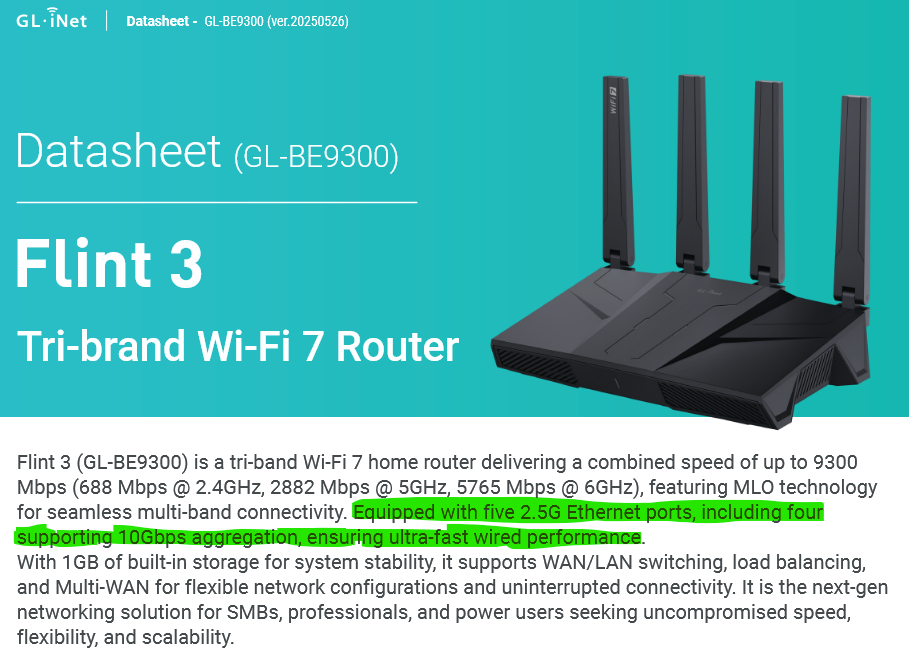
As @Devils3Dust pointed out, link aggregation is a headline feature on the datasheet and the marketing material for the Flint 3. The Flint 3 uses a RTL8372N switch chip and that chip supports LAG, does it not? Therefore is the problem that the hardware doesn't support it or it just hasn't been implemented in software?
Maybe I didn't understand what you meant. About port bonding.
Flint 3 itself has offers 10Gbps LAN aggregation, as stated on the official website.
Supports bandwidth aggregation: The bandwidth of multiple links is combined for use (after aggregating four 2.5Gbps links, the theoretical bandwidth can reach 10Gbps).
Supports failover and load balancing.
Hi @alen5193,
thanks for the reply, but I have a question, which I believe is also the same as @ianfromnyc:
These features usually require activation on the device. Flint3 doesn't seem to have a dedicated menu and/or a section to check if the aggregation has been activated correctly.
Will it be integrated? I have a QNAP NAS that supports various types of aggregation for the two 2.5G ports. These must be enabled on the NAS. How do I check on the router if the aggregation was successful? Any SSH commands?
Sorry @ Devils3Dust @ ianfromnyc, after checking with PM team, I've corrected my statement:
The router itself has four 2.5G LAN ports, totaling 10G, but currently doesn't support link aggregation (LACP).
Due to Hardware and SDK limitations, it does not support the link aggregation feature.
We are truly sorry for any misunderstanding we may have caused you.
This may be due to the possible inaccuracy in the use of marketing terms.
We will re-examine our promotional materials to avoid causing misunderstandings to consumers.
When releasing materials in the future, we will use definitions and terms with greater caution. Once again, we apologize.
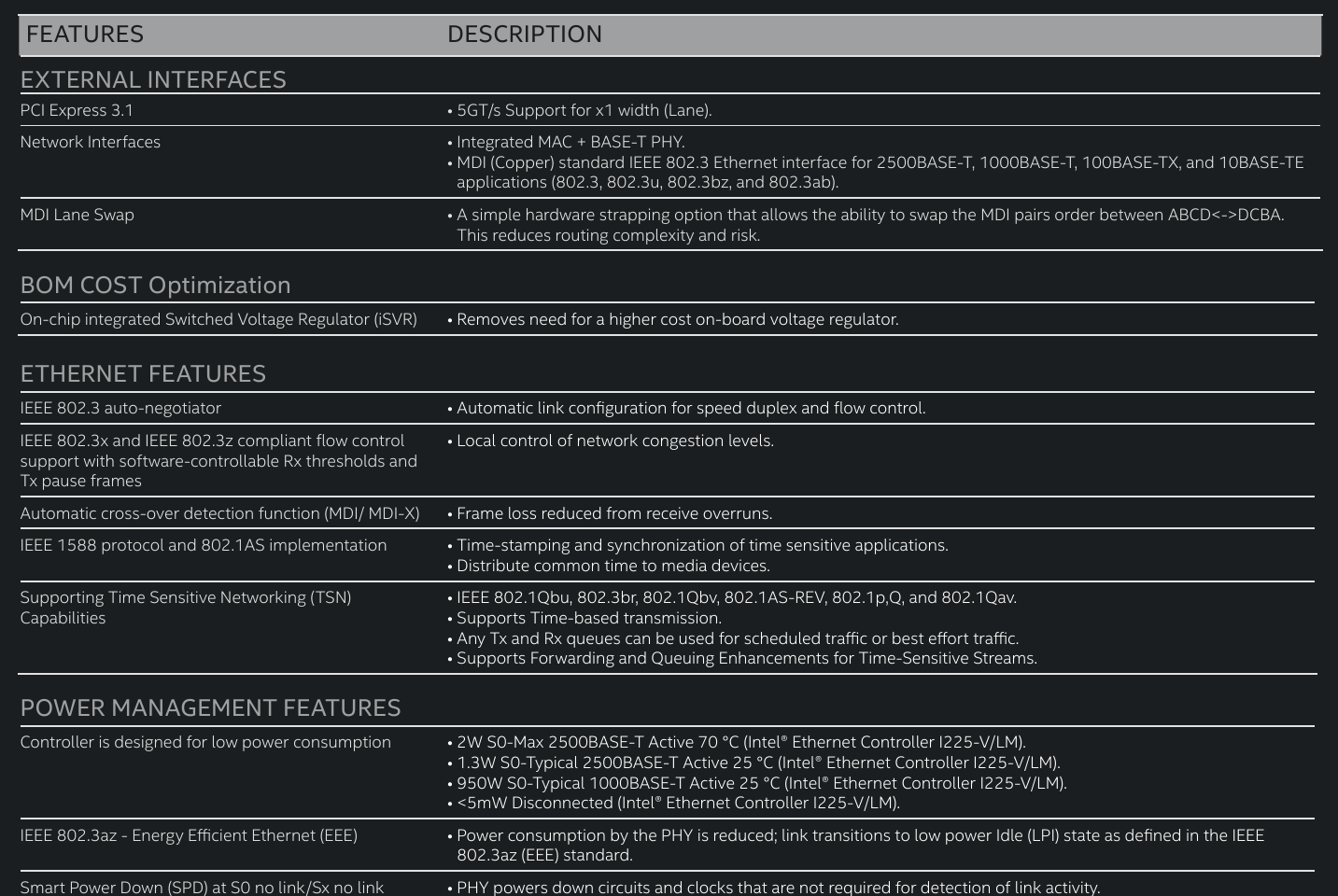
It's stuff like this that makes it hard to take GL.iNet seriously as a ODM (...as much as I want to!). You guys really need to start publishing full specs like Intel, Marvell, Mellanox, Ubiquiti, etc., does when looking @ their network equipment/NICs — including the supported IEEE standards:
I'll say it again, Bruce: GL.iNet is going to be drawing a lot more attention & the corresponding scrutiny that comes with it as the popularity of these devices grows, with everyone from 'digital nomads,' 'home labbers', networking pros & those considering the ODM side of the business for contract work... but the basics really need to be ironed out first.
Thank you for your replies. Can you please be more specific about what exactly the hardware and SDK limitations are?
As far as I'm aware, the switch chip supports this, so it's just a matter of sending the correct configuration from OpenWRT to the switch. (I'm assuming that the kernel is correctly reporting that the switch chip is a RTL8372N, please correct me if that is wrong)
To call this a "possible inaccuracy in the use of marketing terms" seems like a massive understatement, because if "10Gbps link aggregation" doesn't actually mean the ports can be aggregated to provide a single 10G link, then what could that have possibly meant?
I don't even need active LACP, I would be happy with a static LAG using balance-rr to get to 10Gbps.
I'm now stuck with a device that is less capable than the one it is replacing, and I am unable to return it for a refund because I bought it secondhand. I guess now I know why.
I'm also curious from the product manager's point of view, if the ipq5332 has 2x10G interfaces, and one of them is used for the RTL8372N switch to give 4x2.5G LAN ports, why is the WAN port only 2.5G and not 10G? Isn't that wasted capacity?
I can't comment on balance-rr or port aggregation in general as I've never used it... but I'll offer this as perhaps an alternative/hope it'll eventaully meet your goals: OpenWrt has bonding capabilities, unsurprising. Since at least OWRT 23.05.2 luci-proto-bonding give a LuCI interface & will pull down the kmods for it.
IDK if there is a pure (aka 'vanilla') OWRT image for the Flint v3 ATM as the Slate AX only recently got a SNAPSHOT. The Flint v2 has full support but that's a using a MediaTek SOC. Qualcomm's stuff (eg: on the Slate AX) seems to be more troublesome to reverse engineer due to their proprietary SDK for the ipq-series.
TL,DR: It'll take time but I expect pure OWRT will support the Flint v3. It'll take some considerable time though; the Slate AX only got a SNAPSHOT after 2+ years. Thanks, Qualcomm.
Yeah, the QSDK fork does appear to have the bonding kernel module pre-installed (I think some of the new multi-WAN features use it), and since the switch and SDK do seem to properly support VLANs, I should be able to give each physical port its own tagged VLAN and then bond those VLAN interfaces into a LAG group. However, that will result in all traffic being routed via the CPU which may not be able to keep up. Worth a test, though.
There is work ongoing to port vanilla OpenWRT to ath12k, so not all hope is lost on that front.
So if I understand correctly: the advertised feature of 10Gbps LAN aggregation is false? That is very disappointing as that was one of the primary reasons I chose the Flint 3 over a different brand/model. Is there any hope to make this advertised feature a reality?
I think with the FLint 3 GL.Inet did a wrong choice with the CPU.
I have it and im not optimistic at all, if the next updates will also need months.
Flint 2 is also struggling with Updates over many months
Gl.inet do a good job but Opnwrt is one thing, to make the Gl.inet Interface an other and to become SDK from Qualcom the bigest issue i think.
I dont now keep the Flint 3 or give it back. Is there any oppertunity to give it back?
I dont whant a Product to stay without Use and after a Year there is no Solution.
To be fair at least the Flint v2 (GL-MT6000?) has full OWRT support given its MediaTek SOC though there may be some performance losses like in VPN/WG, etc.
To your point re: Flint v3: If I was still in a 30 day return window/period it would be back in its box faster than it takes me to post this comment. If I was not able to return it to the retailer I would post it on somewhere like r/homelabsales & take a loss to recoup whatever you can.